
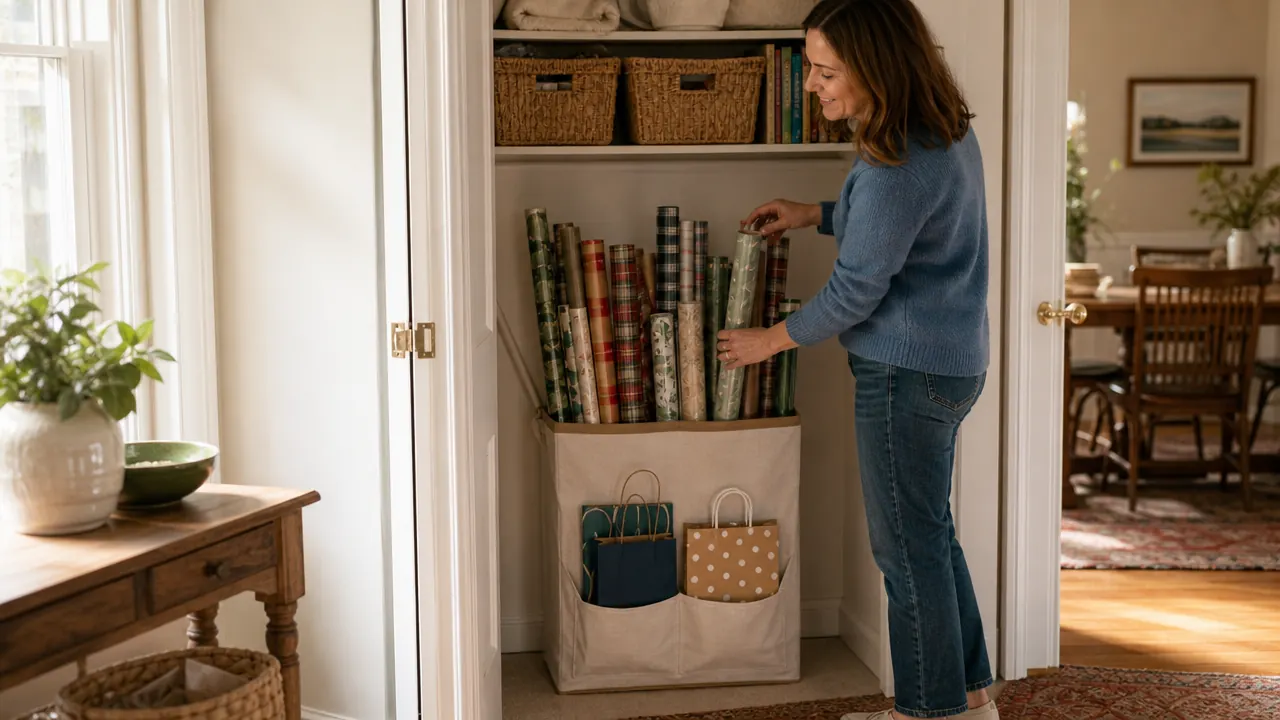
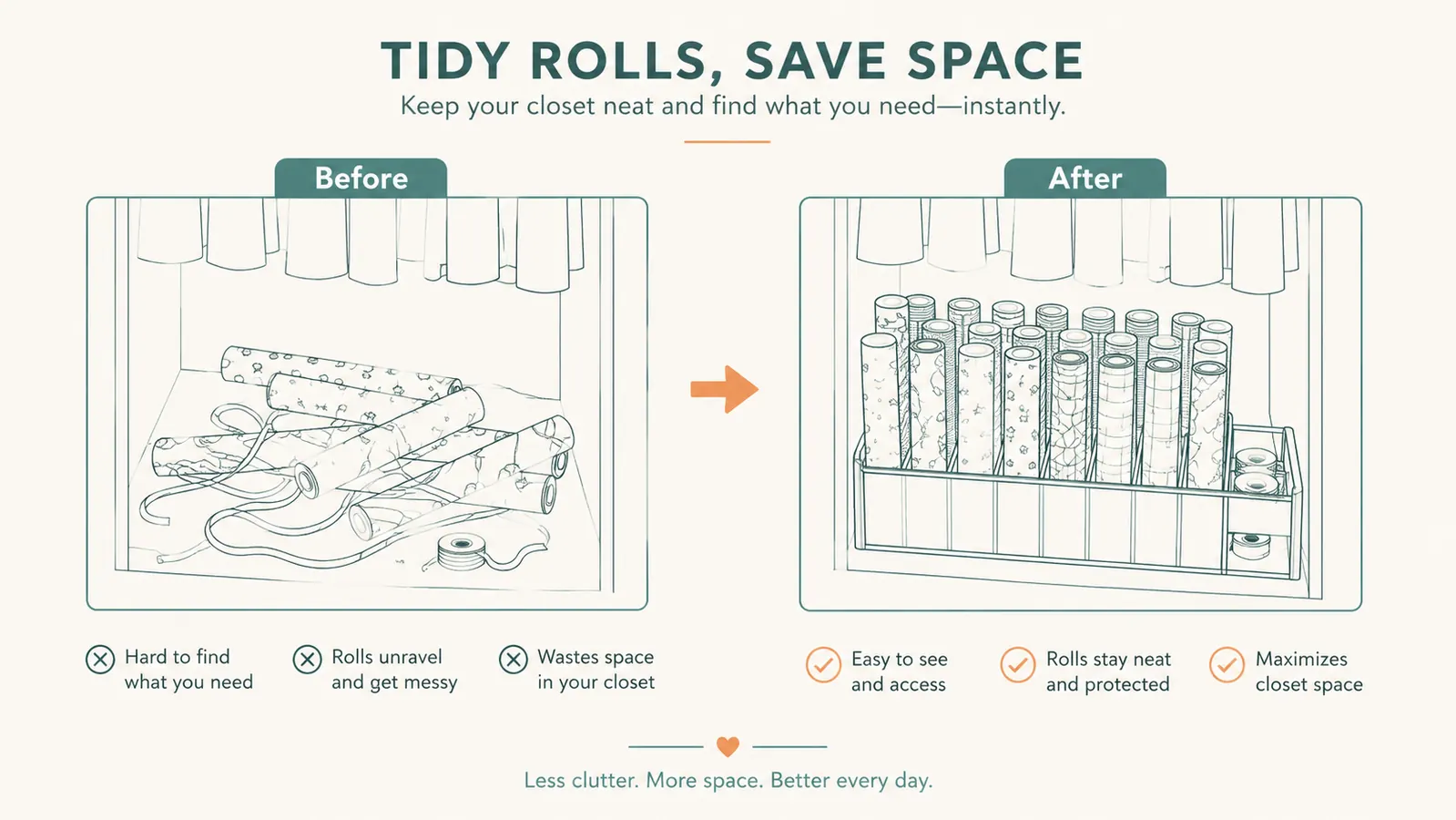
Every year around the second week of November, our hall closet in the house outside Waco turned into a hazard. Six or seven rolls of wrapping paper leaning against the wall, three of them always sliding down at the exact moment I opened the door. Loose ribbon spools rolling under the water heater. A grocery sack of gift bags getting more crushed every time someone grabbed a coat off the hook above it. By Christmas Eve the closet floor looked like a craft store had a small explosion in it.
I finally fixed it the year my daughter Emma turned nine and I got tired of wrapping her presents on the kitchen floor because I couldn't find anything in that closet without pulling half of it out first. What actually solved it wasn't a bigger closet, it was a dedicated wrapping paper organizer that gave every roll, ribbon spool, and gift bag its own spot. I've been using the Homior fabric organizer for over a year now, through two Christmases, three birthdays, and one very last-minute baby shower, and it's still holding its shape. Below is exactly how I set mine up, because the organizer itself only works if you load it right, and I learned that the hard way with two other storage bins before this one.
Stop Digging Through a Pile of Rolls Every Time You Wrap a Gift
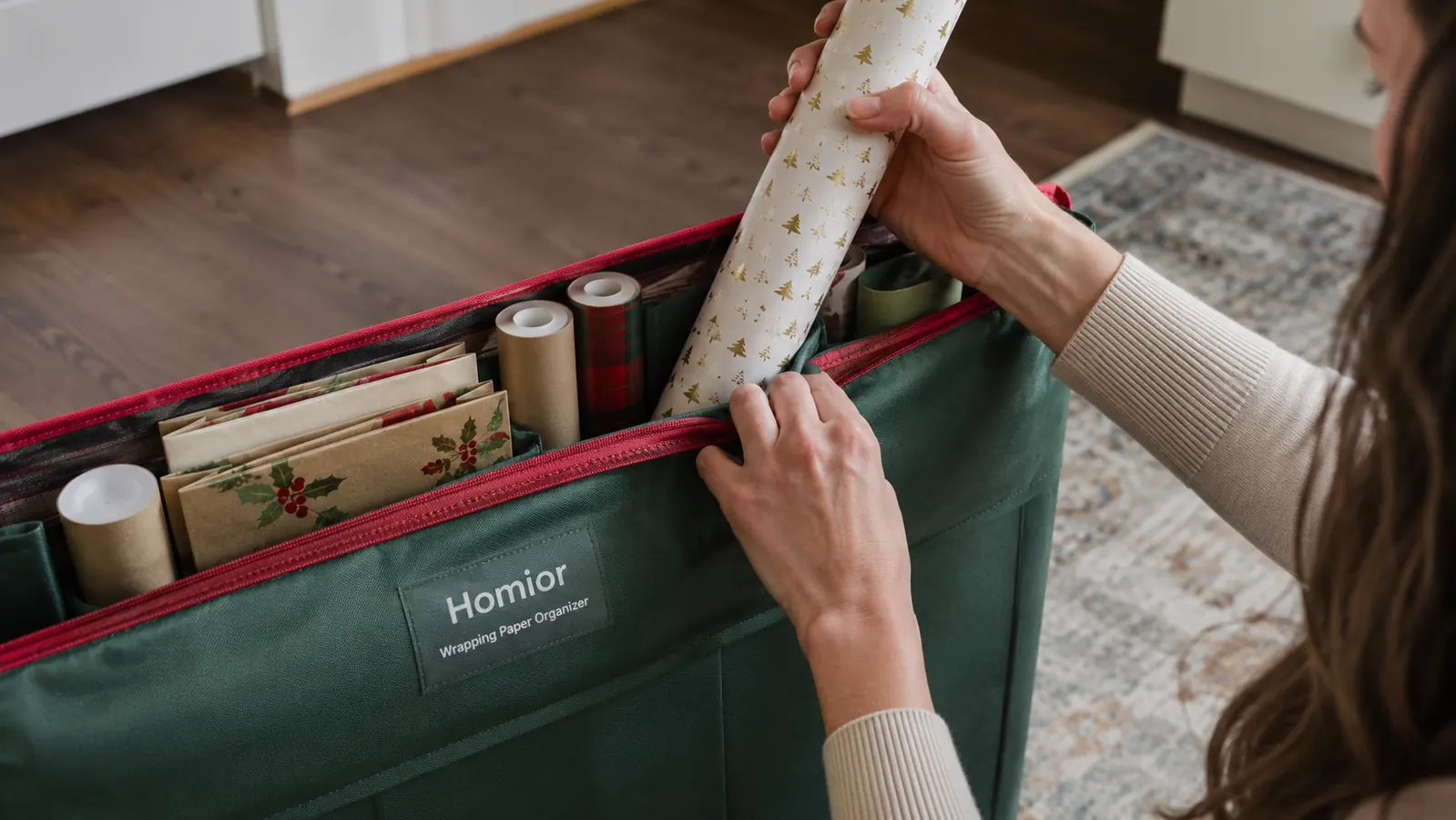
The Homior organizer holds up to 27 rolls upright with extra pockets for ribbon, bows, and gift bags. It's the same one I've used through two full holiday seasons without a seam giving out.
Amazon Check Today's Price on Amazon →Step 1: Pull everything out and sort it into three honest piles
Before you store a single thing, empty the closet completely. I mean everything, including the roll of paper that's been sitting behind the water heater since two Christmases ago. Lay it all out on the living room floor or a big table so you can actually see what you own. You will almost always find more than you think, mostly because wrapping paper gets bought twice a year, once at the after-Christmas clearance sales and once when you panic-buy at the drugstore three days before a birthday party.
Sort into three piles: keep, toss, and gift-away. Toss anything torn more than a few inches in from the end, since that's usually unusable once you account for pattern matching. I also toss any roll that's gone soft or bent in the middle, because it never lies flat again no matter how carefully you wrap around it. The gift-away pile is for patterns you bought on a whim and never use, like the four rolls of Halloween paper I bought in 2023 and still have three and three-quarter rolls of. A neighbor with younger kids took those off my hands.
This step feels slow, but it's the step people skip, and it's why so many closet systems fail within a month. If you load a new organizer with paper you don't actually want, you've just built a nicer-looking version of the same mess. I got my keep pile down from 31 rolls to 19 the first year I did this, and that alone made the whole closet feel calmer before I'd even bought a single storage product. I also learned to be honest about duplicates. I had four rolls of the same gray-and-white kraft paper because I kept forgetting I already owned it, and that's a full grocery bag of space you can get back just by admitting you don't need a backup of a backup.
Step 2: Measure your rolls before you pick an organizer
Standard wrapping paper rolls run about 24 to 40 inches long, but jumbo rolls and the extra-wide paper made for large gifts can run longer. Before you buy anything, stand your tallest roll up next to a tape measure. This matters more than people expect, because a lot of the cheaper organizers on the market are sized for the shorter 20-inch rolls you find at drugstores, and a full-size 40-inch roll will poke straight out the top or refuse to zip closed.
I made this mistake with a cardboard box organizer I bought years ago from a big box store. It looked fine in the photos, but every roll I owned was too tall for it, so the lid never sat flat and dust got in anyway. When I switched to the Homior organizer, the first thing I checked was the interior height, since it's built to fit rolls up to 40 inches standing upright with room to spare. That one detail is the difference between a closet that looks tidy and one that just has a slightly nicer pile in it. I keep the tape measure clipped right to the organizer's handle now, so if I ever add a new roll I can check it against the bag before I even bring it inside the house.
Also count your rolls honestly. If you kept 19 after sorting, look for something rated to hold at least that many with a little room to grow, because you will buy more paper before you throw any away. The 27-roll capacity on mine gave me room for the eight new rolls I picked up at the after-Christmas sale that same year, and I still have two open slots as of this July.
Step 3: Load it in the order you actually wrap in
This is the part nobody tells you. Don't just shove rolls in by color or by size. Load them in the order you reach for them. I keep my everyday kraft paper and birthday prints in the front pockets, because those get used every month or two, and I push the Christmas-specific patterns to the back since they only come out for six weeks a year. It sounds small, but it means I'm not elbow-deep in holiday paper trying to find a birthday roll in April.
The Homior organizer has side pockets built specifically for ribbon spools, bows, and tissue paper, and using them for their actual purpose matters. I used to toss loose ribbon in a shoebox that lived on top of the paper, and it always ended up in a tangle that took ten minutes to sort through before I could even start wrapping. Now the ribbon spools slide into their own pocket standing up, and I can grab the right color without unwinding three others first.
Flat items like tissue paper sheets and gift bags go in the wider front pockets so they don't get crushed under the weight of the rolls. I fold my gift bags flat, largest on the bottom, smallest on top, and that alone stopped the crumpled-bag problem I used to have every single year. If a bag came out looking pressed and sad, it usually meant I'd be buying a new one anyway, so this step alone has probably saved me money a year. I also learned to keep a spare roll of tape and a pair of scissors clipped near the front pocket, so wrapping never turns into a scavenger hunt through three different kitchen drawers before I can even start.

Step 4: Pick a spot where you'll actually use the system
An organizer only works if it lives somewhere you'll open it without a fight. I originally put mine on a high closet shelf, thinking it would be out of the way, and within two months I'd stopped using it because I had to drag a step stool over every time I needed a roll. I moved it to the closet floor, upright against the back wall, and that one change made the difference between a system I maintain and a system I abandon.
The reinforced handles on the Homior organizer make this easy, since you can carry the whole thing fully loaded without the seams stressing out. I actually pull mine out into the hallway when I'm wrapping a stack of gifts, wrap everything at once on the floor, then slide it back into the closet when I'm done. That's a habit that only works because the bag has real handles and doesn't sag when you lift it, which was a problem with the canvas tote I tried before this one.
If closet space is genuinely tight, these organizers also work standing in the back of a coat closet, tucked beside a dresser, or even in the corner of a home office. The point isn't finding a perfect spot, it's finding a spot you'll actually walk to instead of working around. I also learned to keep a small stool nearby anyway, not for the organizer itself, but for the shelf above it where I keep gift tags and extra tissue paper, since those get used less often and can live a little higher up.
Step 5: Maintain it through the holiday rush, not just after
The real test of any storage system isn't October, it's December 23rd when you're wrapping fourteen gifts in one sitting. That's when systems fall apart, because you're moving fast and tempted to just toss things back in wherever they land. I've learned to do a two-minute reset after every wrapping session, sliding rolls back into their assigned pockets and coiling loose ribbon before I walk away, instead of leaving it for later, the kind of later that never actually comes.
I also do a mid-January check where I toss any rolls that got torn up during the rush and note what I'm low on before the after-Christmas sales end. That way I'm buying replacement paper at 75% off instead of full price in November. It takes maybe ten minutes and it's the single habit that's kept this system working for over a year instead of collapsing back into a pile by the second holiday season.
One more thing that helps: label the outside pockets if your organizer has a clear window or tag, especially if more than one person in the house wraps gifts. My husband Rob used to just grab whatever roll was closest, which meant the good patterns disappeared fast. A quick label fixed that faster than any conversation did. It's a habit I had to build the same way I built any other household routine, by doing it badly a few times before it finally stuck.
What Else Helps
A few small additions make the whole system run smoother. A roll of painter's tape or washi tape clipped to the outside pocket means you're never hunting for tape mid-wrap. A pair of fabric shears stored in one of the small pockets saves you from using kitchen scissors that dull the blade on tape residue. And if you do a lot of gift-giving, keeping a small notepad in the front pocket to jot down what paper you're running low on makes that after-Christmas sale trip a lot more efficient than trying to remember from memory in a crowded store aisle. I also keep a small roll of extra-wide clear tape for oddly shaped gifts, since standard tape rolls never seem to be strong enough for anything heavier than a book.
The organizer didn't make me a naturally tidy person. It just gave my mess a specific place to live, and for a busy household, that's really all organization ever is.
Give Your Wrapping Supplies a Real Home Before the Next Holiday Rush
If your closet floor looks like mine did two years ago, the fix isn't more willpower, it's a system built for how you actually wrap. The Homior organizer is the one I still reach for every single time.
Amazon Check Today's Price on Amazon →